
1948 – Alfred Kinsey, an American biologist and sexologist at Indiana University issues the first report, Sexual Behavior of the Human Male, was published and discussed male homosexuality (Also known as the Kinsey report).
1950 – U.S. Congress issues the report entitled “Employment of Homosexuals and Other Sex Perverts in Government” is distributed to members of Congress after the federal government had covertly investigated employees’ sexual orientation. The report states that since homosexuality is a mental illness, homosexuals “constitute security risks” to the nation. The investigation by the U.S. Senate led by Sen. Joseph McCarthy, with chief counsel Roy Cohn, was known as the Lavender Scare and resulted in the firing of many gay men and women from the federal government.
1950 – The Mattachine Society formed in Los Angeles, California by activist Harry Hay and is one of the first sustained gay rights groups in the United States. The organization focused on social acceptance and other support for homosexuals. Various branches formed in other cities.
1952 – Christine Jorgensen became one of the most famous transgender people when she underwent a sex change operation and went on to a successful career in show business.
1952 – The American Psychiatric Association’s diagnostic manual lists homosexuality as a sociopathic personality disturbance that could be treated.
1952 – U.S. Congress passed, and President Harry S. Truman signed into law the Immigration Act that barred “aliens afflicted with a psychopathic personality, epilepsy or mental defect.” Congress made clear that this was meant to exclude “homosexuals and sex perverts.”
1953 – Kinsey Report, Sexual Behavior in the Human Female, was published and discussed female homosexuality.
1953 (April 27) – Executive Order 10450 issued by President Dwight D. Eisenhower banning homosexuals from working for the federal government stating they are a security risk. This order stays in place until 1993 when President Bill Clinton and the U.S. Congress enact the “Don’t Ask, Don’t Tell” law.
1955 – Daughters of Bilitis, the first lesbian rights organization founded in San Francisco, California by Phyllis Lyon and Del Martin. They hosted private social functions, fearing police raids, threats of violence and discrimination in bars and clubs. They began publishing their newsletter The Ladder in 1956. The organization lasted until 1969.
1957 – Frank Kameny, an astronomer for the U.S. Army Map Service, was released from government service because of his homosexuality, an outgrowth of Executive Order 10450. He had earned his doctorate in astronomy from Harvard University and was a professor of astronomy at Georgetown University before taking a government position. Kameny appealed the decision to the Supreme Court but was rejected.
1958 – One v. Olesen (Supreme Court Decision)
Without oral arguments, the Supreme Court issued a decision stating that first amendment free speech rights protected the publishing of “One Magazine”. Up to this point in time the U.S. Postal Service had the power to open any magazine or mail they determined to be “obscene, lewd, and/or lascivious.” They also had the power to keep lists of people who received such publications; and had lists of homosexual men who received the publication, “One Magazine.” The publication was a gay man’s publication associated with the Mattachine Society.
1961 – Jose Sarria becomes the first openly gay candidate to run for public office in the U. S., running for a seat on the San Francisco Board of Supervisors. He lost his race. He was a chef, drag queen and army veteran who started two of the earliest LGBTQ+ organizations in San Francisco in 1960 and 1963, the second lasting 17 years.
1961 – Frank Kameny, an astronomer dismissed from government service, forms the Washington D.C. branch of the Mattachine Society (The society was originally founded in Los Angeles in 1950).
1961 – Philadelphia activists form the Janus Society to work for LGBTQ+ civil rights.
1962 – Illinois becomes the first state to decriminalize homosexual acts between two consenting adults in private.
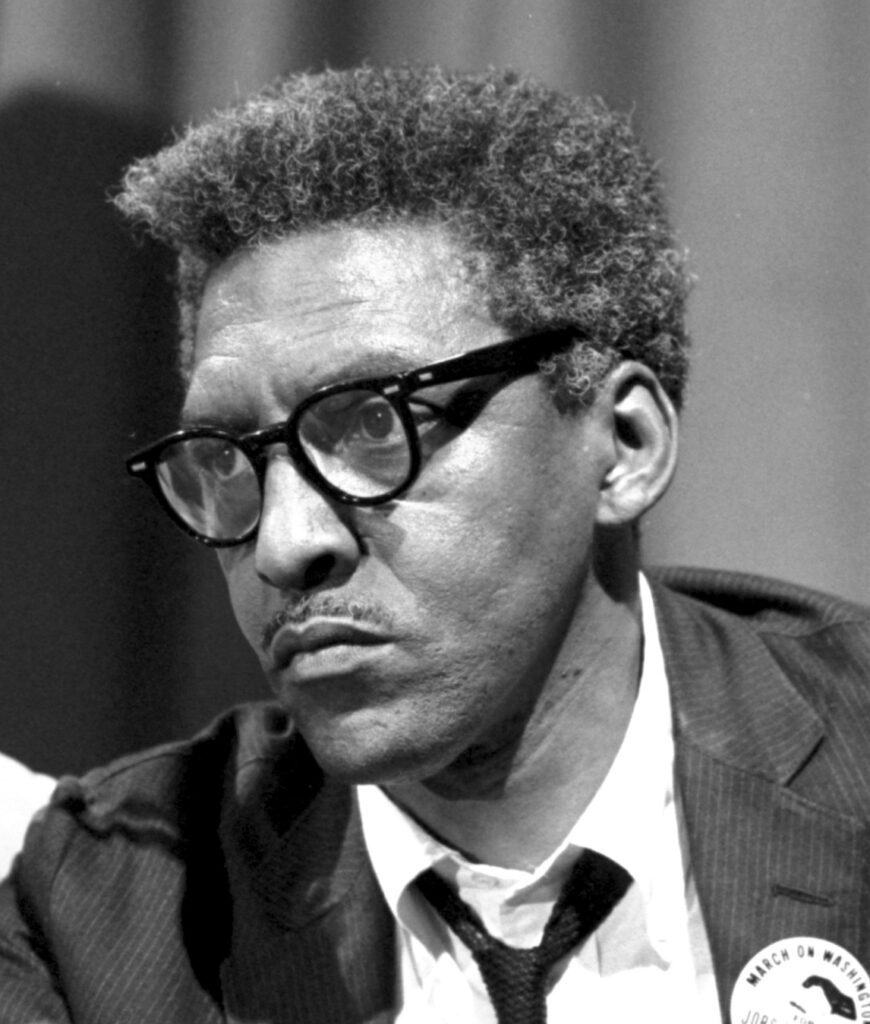
1963 – Bayard Rustin, an associate of Martin Luther King, and a gay African American man helped organize the March on Washington that culminated with King’s ‘I Have a Dream’ speech. Rustin had an extensive resume of activism in the Black civil rights movement and was considered one of MLK’s closest associates. He was born in West Chester, PA and attended Cheyney University. His outing as a gay man forced him to accept a less prominent role in the civil rights movement in later years.